The Case for the Householder
The prosecution begins strongly.
The removal company had promised to arrive between eight and ten.
They appeared at eleven-fifteen.
The householder had spent the intervening period standing at the window every four minutes, becoming steadily more convinced that the entire removal industry had conspired against him personally.
When the van finally arrived, matters did not improve.
A table was scratched.
A lampshade disappeared.
One corner of the hallway now bore a suspiciously wardrobe-shaped mark.
And somewhere between the old house and the new one, a box containing important documents, phone chargers, medication, the kettle, and apparently the family’s entire ability to function vanished without a trace.
The householder presents his final piece of evidence.
A broken vase.
“This,” he announces, “was my grandmother’s.”
The courtroom falls silent.
Even the executioner lowers his axe.
The judge looks sternly at the removal company.
“Was this item packed correctly?”
The householder hesitates.
The judge notices.
So does everyone else.
The clerk dips his quill into the ink with unnecessary enthusiasm.
“How was it packed?”
Another pause.
“In newspaper.”
“How much newspaper?”
The householder considers this.
“One sheet.”
There is a sound from the gallery normally associated with the announcement of a public execution.
The removal men exchange glances.
The executioner sighs and leans back against the wall.
The Defence
Now it is the removal company’s turn.
Their representative approaches the bench carrying a list, a very long list.
The clerk sees it and quietly reaches for a second bottle of ink.
“My Lord, when the quotation was given, we were told this was a straightforward three-bedroom move.”
The judge nods.
“We subsequently discovered a loft.”
The court murmurs.
“A garage.”
More murmuring.
“A garden shed.”
Someone at the back whispers a prayer.
“And seventeen large plant pots.”
The householder objects.
“The plants are not furniture.”
“No,” replies the removal man, “but they were made of stone.”
The executioner looks towards the plant pots with professional respect.
The list continues.
The access road was narrow.
There was nowhere to park.
The new property had two more flights of stairs than had been mentioned.
The bed had not been dismantled.
Neither had the wardrobe.
And the washing machine was still connected when the removal team arrived.
The judge raises an eyebrow.
“Is this true?”
The householder shifts uncomfortably.
“I thought they did that.”
There is a collective intake of breath.
A woman in the gallery mutters, “God preserve us.”
The executioner slowly straightens.
Even the raven outside goes quiet.
The Wardrobe
Every moving dispute has a moment when things cease to be rational.
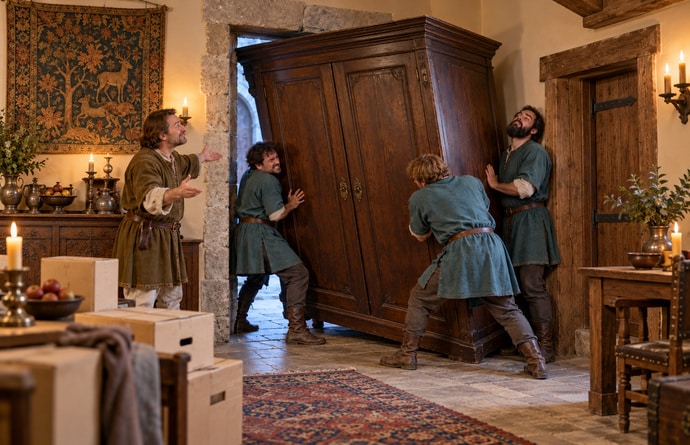
In this case, it was the wardrobe.
The wardrobe was in the house.
Everyone agreed on this.
The difficulty was that it now appeared physically impossible to get it out.
Four removal men had tried.
The householder had tried.
The householder’s brother-in-law, who had arrived halfway through proceedings and immediately assumed command despite having no relevant qualifications whatsoever, had also tried.
Nothing worked.
And then came the sentence that has probably broken more removal teams than any other words in the English language.
“It fitted when we moved in.”
The judge stares at the householder.
“You are certain?”
“Absolutely.”
“Through this doorway?”
“Yes.”
“Fully assembled?”
A pause.
“I think so.”
The removal men close their eyes.
Someone in the gallery whispers, “Witchcraft.”
Another voice says, “Burn the wardrobe.”
The judge bangs his gavel.
“There will be no burning of evidence in this court.”
The executioner looks disappointed again.
The Witnesses
The first witness is the neighbour.
She had observed most of the move from behind her curtains and therefore considers herself unusually well qualified to give evidence.
“The movers were standing around for ages,” she tells the court.
“What were they doing?”
“Waiting.”
“For what?”
“For the keys to the new house.”
The court turns slowly towards the householder.
The householder coughs.
Somewhere beneath the floorboards, something scratches once and stops.
The second witness is the estate agent.
Unfortunately, the estate agent can remember almost nothing.
The keys were definitely available.
Probably.
At some point.
The clerk stops writing and simply stares.
The third witness is the householder’s partner.
“Did you finish packing the kitchen before the removal company arrived?” asks the judge.
“Yes.”
The removal men look surprised.
“Except for the things we needed.”
“How many things?”
“Not many.”
The clerk begins writing.
“Toaster. Coffee machine. Plates. Cutlery. Saucepans. Food cupboard. Contents of refrigerator.”
The judge looks up.
“Anything else?”
“The drawer.”
Everyone in the court understands immediately which drawer she means.
Every home has one.
Batteries.
Old keys.
Takeaway menus.
Three dead pens.
Sixteen cables belonging to devices nobody remembers owning.
A screwdriver.
An instruction manual for an appliance disposed of in 2014.
Nobody wants to pack the drawer.
Nobody knows how to pack the drawer.
The drawer simply moves with you through life.
At the back of the hall, an old monk makes the sign of the cross.
Exhibit A
Then the clerk brings forward the evidence.
A battered cardboard box.
Nobody recognises it.
There is no label.
No room written on the side.
No helpful arrow indicating which way is up.
Just a box.
The torches nearest to it flicker.
The raven begins making a great deal of noise outside.
“Does this belong to you?” asks the judge.
The householder shakes his head.
“No.”
The removal company representative frowns.
“It was in the house when we arrived.”
“It most certainly was not.”
“It was loaded with everything else.”
“By whom?”
Nobody answers.
The executioner takes one careful step away from the box.
This does not improve the mood.
The judge studies it.
“What is inside?”
The clerk hesitates.
For the first time all evening, he does not appear eager to do his job.
He opens it.
One child’s sock.
Several cables of unknown purpose.
And the missing kettle.
The householder points triumphantly.
“Aha!”
The removal men look genuinely baffled.
Nobody remembers packing it.
Nobody remembers carrying it.
Nobody remembers seeing it before.
Yet somehow it travelled from one house to another.
A voice from the gallery whispers, “Sorcery.”
The judge orders the box closed.
The clerk obeys immediately.
For reasons nobody can quite explain, everyone is relieved when it is.
Who Ruined Moving Day?
And hereby lies the difficulty with our trial.
Because the householder has a point.
The movers were late.
Something was scratched.
Communication could have been better.
And yes, somewhere along the way a lampshade really did disappear.
But the removal company has a point too.
The move was larger than described.
The packing was not finished.
The access was worse than expected.
And nobody had mentioned the wardrobe.
The truth is that most disastrous moving days are not created by one enormous mistake.
They are created by dozens of tiny ones.
A forgotten conversation.
An assumption.
A box that should have been packed yesterday.
A parking restriction nobody checked.
A piece of furniture nobody measured.
One person thinking the other person was taking care of something.
Then moving day arrives and all those small problems meet each other at exactly the same time.
Usually in a narrow hallway, while it is raining cats and dogs outside.
And while somebody is asking whether anyone has seen the kettle.
The judge listens to both sides in silence.
The executioner, having heard all the evidence, now appears uncertain which party he dislikes more.
The Verdict
Eventually, the judge rises.
The hall becomes silent.
Even the rain seems to hesitate.
The householder grips the packing tape.
The removal men stare ahead.
In the shadows, the executioner straightens hopefully.
“This court has reached its verdict.”
“The removal company is found guilty of excessive optimism regarding arrival times, insufficient respect for fragile objects, unexplained scratches, and spending suspicious amounts of time standing in hallways saying, ‘That’s never going through there.'”
The householder smiles.
“However…”
The smile disappears.
“The householder is found guilty of unfinished packing, concealed staircases, inaccurate descriptions of furniture, possession of seventeen stone plant pots, and repeatedly uttering the cursed phrase…”
The judge leans forward.
“It shouldn’t take long.”
There is a gasp from the court.
Someone faints.
The raven outside gives an approving croak.
The judge raises his gavel.
“Normally, crimes of this seriousness would demand the stocks.”
The executioner takes one step forward.
“Perhaps the dungeon.”
Another step.
“Possibly something involving boiling oil.”
The executioner brightens considerably.
The judge considers the prisoners.
“But this court believes there are punishments more terrible still.”
Everyone freezes.
The judge points towards the householder.
“You shall pack an entire four-bedroom house using only supermarket boxes, six inches of tape, and an almost dry marker pen.”
A scream echoes through the hall.
He turns towards the removal company.
“You shall carry everything.”
The removal men go pale.
“Up four flights of stairs.”
One crosses himself.
“With no lift.”
Another whispers a prayer.
“And the wardrobe…”
The courtroom falls silent.
“…shall remain fully assembled.”
“No!” cries one of the removal men.
The judge strikes the bench.
“SILENCE.”
The householder is trembling now.
The judge has not finished.
“There shall be no parking outside the property.”
A horrified murmur spreads through the court.
“The keys to the new house shall arrive three hours late.”
Someone at the back retches.
“And when you finally reach your destination…”
The judge pauses.
The executioner slowly removes his hood.
Even he looks concerned.
“…you shall discover that the sofa does not fit through the door.”
The householder collapses.
One of the removal men begins openly weeping.
The judge raises his gavel one final time.
“And this ordeal shall continue…”
He pauses.
“…until every box has been unpacked.”
The courtroom erupts.
“Mercy!”
“Please!”
“Anything but that!”
The candles go out.
Darkness fills the hall.
And somewhere beneath the judge’s bench comes a faint scratching sound.
Everyone freezes.
The clerk slowly looks down.
The battered cardboard box is gone.
From somewhere deep inside the walls comes the unmistakable sound of a kettle clicking on.
Avoid Your Own Moving Day Horror Story
Thankfully, most moving days do not require a medieval court, an executioner, or allegations of sorcery to establish what went wrong.
Preparation is the key to a successful moving day.
Be honest with your removal company about how much you have to move. Mention stairs, difficult access, large furniture, and anything particularly heavy or awkward.
Finish packing before the movers arrive.
Measure the things that may not fit.
And make sure you know exactly what your removal company will, and will not, be responsible for on moving day.
It also helps to choose your mover carefully in the first place.
Read genuine removal company reviews, compare several companies, and ask plenty of questions before accepting a quotation.
Because there are enough surprises on moving day already.
And if, while unpacking, you discover an old cardboard box that nobody remembers packing…
Perhaps leave that one until morning.
Happy Halloween from Removal Reviews.
Also Read















Share your thoughts by leaving a comment